WHAT TO EXPECT
In & Beyond Session
In Session: Collaboration & Presence
-
The New Commons was founded to create many ongoing new commons — spaces that bring together intellectual rigor, equal voices, and connection. We aim to provide a unique space for critical yet spacious discussion that inspires passion, curiosity, and connection around books we all want to more deeply understand.
Our goal is for everyone to feel well-equipped to closely read the book; if you’ve done that, you have done an amazing job. From there, in sessions, we co-create a space that is intellectually inspiring—a space for ideas to be voiced, deepened, and challenged in a supported and personal way. We keep cohorts small so that trust can be built along the way.
We always encourage people to take on new roles in the dialogue. Sometimes, this means being brave enough to say “I don’t know;” other times, it’s about speaking with authority, even if you don’t know.
-
Book cohorts are always capped at eight students. Our cohorts are designed to be small to make sure the space is truly inclusive for everyone who enrolls.
This kind of small learning environment is necessary for actually building trust and relationships with each other for the sake of learning. It’s our goal that each person feels free to express their thoughts, participate multiple times, take risks, and work collaboratively — with dignity, respect, and curiosity.
-
Whether you’re in a cohort with Lauren, Ris, or Jules, all of us have studied literature in depth, with years of experience being at the front of the classroom in educator and facilitator roles. We teach books that we have spent significant time with in research and study.
While no two cohorts or dialogues will be the same, we spend many hours designing the curriculum and key learning objectives for each book we read. We act as both facilitators and teachers, guiding the cohort through key themes, questions, and contexts within the book—and through a focused discussion with each other.
We open each discussion with Recap and Recall, where we bring everything from hot takes to big outstanding questions to key words or phrases that we loved. Then we begin discussion with an Opening Question. The question is designed by the facilitator to open up the text and set participants up for a lively, focused, challenging discussion. When Recall is lively, another Opening Question may naturally arise—and then we follow that thread of inquiry.
-
We read one book over the course of many sessions so we can linger on certain passages and let a thread of inquiry run its course. We want there to be plenty of time to flip backward and forward, so readers can develop a relationship with the language. Our goal is for each participant to go from “visitor” to “guide” of the book, leaving their cohorts with a mental map of the text, with a strong sense of its themes, language, and questions, and with memory and evidence of their personal reading journey.
Beyond Session: Community & Practice
-
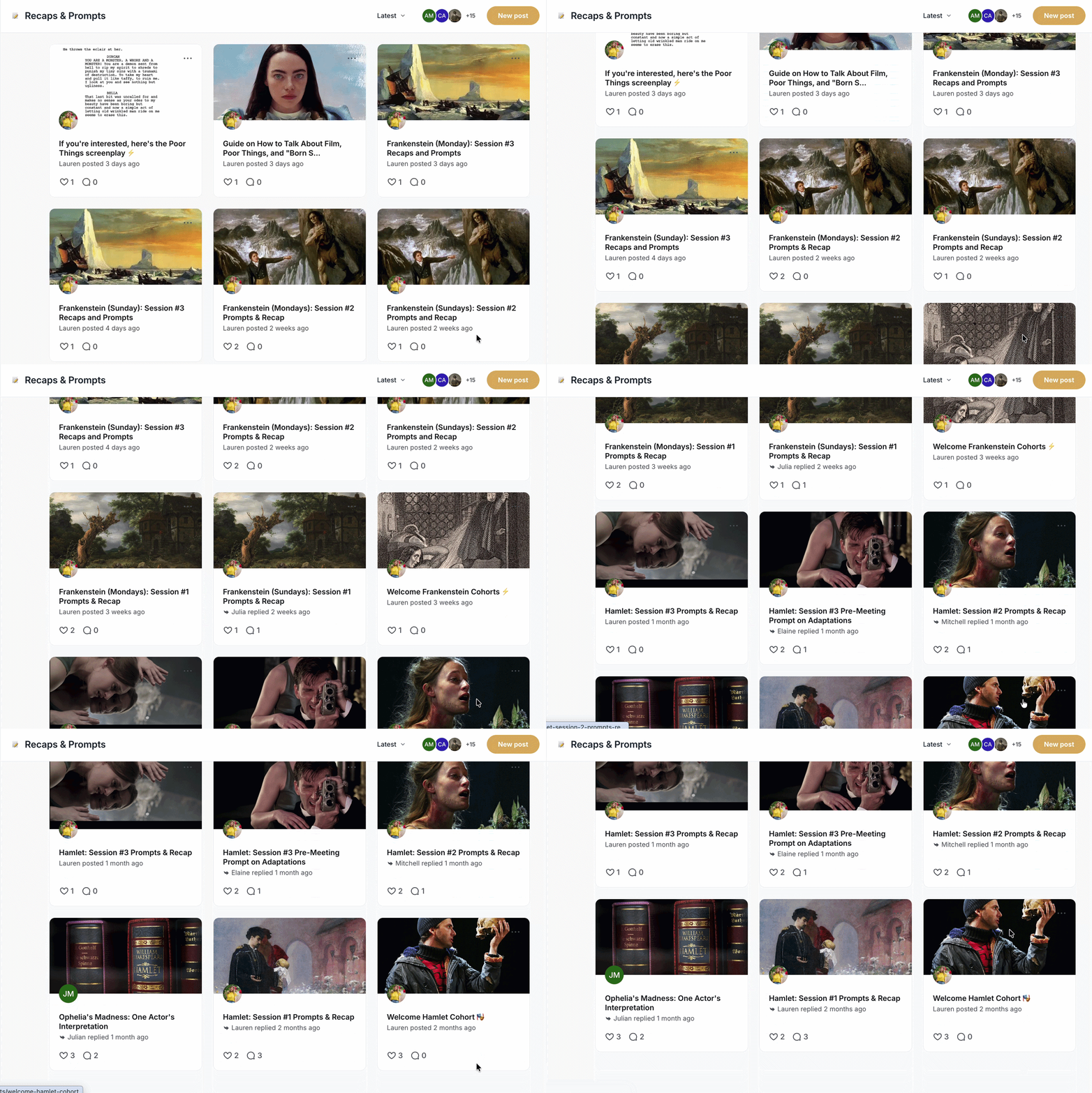
When you sign up for a book cohort, you gain access to our online Circle community, a wonderful centralized platform for all of our members. In it you’ll find:
Guides on how to talk about film for the text-art pairing
Session recaps and prompts
Recommended reading for continued engagement with a text, including scholarship, art, performance, and more
Space for participants to continue the conversation even after session is over
-
At the end of each session, the instructor provides three writing prompts for research, creative writing, and journaling, which participants can share with each other online if they wish. See a few examples below:
Research Prompts:
Research a new technology that is an example of humans “tampering with Nature.” Is there a scenario in which this technology is morally neutral, or do you find it inherently good or bad? Why?
Do a deep dive into the 19th-century legal context in which Mary Shelley was writing. How does this inform how we read guilt and parent-child responsibility?
Creative Writing Prompts:
Write a feminist revision of a short scene of Hamlet from the perspective of Gertrude or Ophelia.
Write a short story where you, like The Creature in Frankenstein, stumble upon a satchel in the woods. It contains three books that inform the way you think about the world. Which three books do you find? How do they inform—or misinform—your view of the world?
Journal Prompts:
Are there areas of your life where you put on an “antic disposition” in order to scheme — or to survive? Describe that state of mind. Free-write into your own “method of madness.”
Have you ever accomplished something big only to despise it or abandon it as soon as it was finished? How have you processed that disappointment, grief, loss, or shift in expectation?
Commune with your inner “monster.” Write a dialogue between you and yourself. What are their demands?
-
As a collaborative online literary space open to all, we are big believers that deep learning happens when there is a shared language around shared best practices and goals.
These guidance documents aim to provide a basic shared framework for reading and congenial discussion. Explore them here: